
The Art of the Blend (Part 2)
|
Last week we covered why winemakers blend — complexity, consistency, balance, terroir, tradition — and walked through the two blending traditions that shaped the wine world: Bordeaux and Champagne. |
|
|
|
|
THE RHÔNE: The southern Rhône is where the rules get interesting. While Bordeaux blends five grapes in fairly well-understood proportions, Châteauneuf-du-Pape permits up to 18 varieties. Red and white, old and obscure, some of which you’ve probably never heard of. It’s less a formula and more an open invitation. In practice, most estates build their blends around three grapes (Grenache, Syrah, and Mourvèdre, collectively known as GSM), and use the rest to fine-tune. But the differences in how each producer weighs those three grapes produces wines that can feel almost unrelated to each other, despite coming from the same appellation. A Beaucastel, with its unusually high Mourvèdre, tastes nothing like a Grenache-forward estate down the road. That’s the beauty of it.
|
|
Grenache |
|
The dominant grape of the southern Rhône — generous, warm, and high in alcohol, with red fruit, white pepper, and a silky texture that can feel almost pillowy. It’s the soul of Châteauneuf-du-Pape. The catch: Grenache oxidizes easily and has almost no natural color, which is exactly why it needs company. |
|
Syrah |
|
Where Grenache is round and warm, Syrah is dark and precise. It adds color, tannin, and the savory depth — smoked meat, cracked pepper, dark olive — that gives great Rhône reds their complexity. A little goes a long way. |
|
Mourvèdre |
|
The most challenging variety to grow and vinify, and the most distinctive. Mourvèdre brings leather, iron, garrigue, and an almost feral earthiness that’s either captivating or alarming depending on your palate. Estates that use it heavily (Beaucastel is the obvious example) make wines that can age for 20+ years and emerge completely transformed. |
|
Cinsault |
|
Light-bodied and highly aromatic, with bright red fruit and floral notes. It keeps the blend from feeling heavy and adds a freshness that Grenache alone can’t provide. Increasingly valued by natural wine producers for exactly these qualities. |
|
|
|
|
✨ PRO TIP: Read the Back Label If there’s one habit worth taking from these two issues, it’s this: flip the bottle over and read the blend before you pour. If the percentages are listed, take a moment to think about what each grape is doing in the glass based on what you now know.
|
|
Grenache-dominant?
|
|
Cab Franc-forward?
|
|
High Mourvèdre?
|
|
|
|
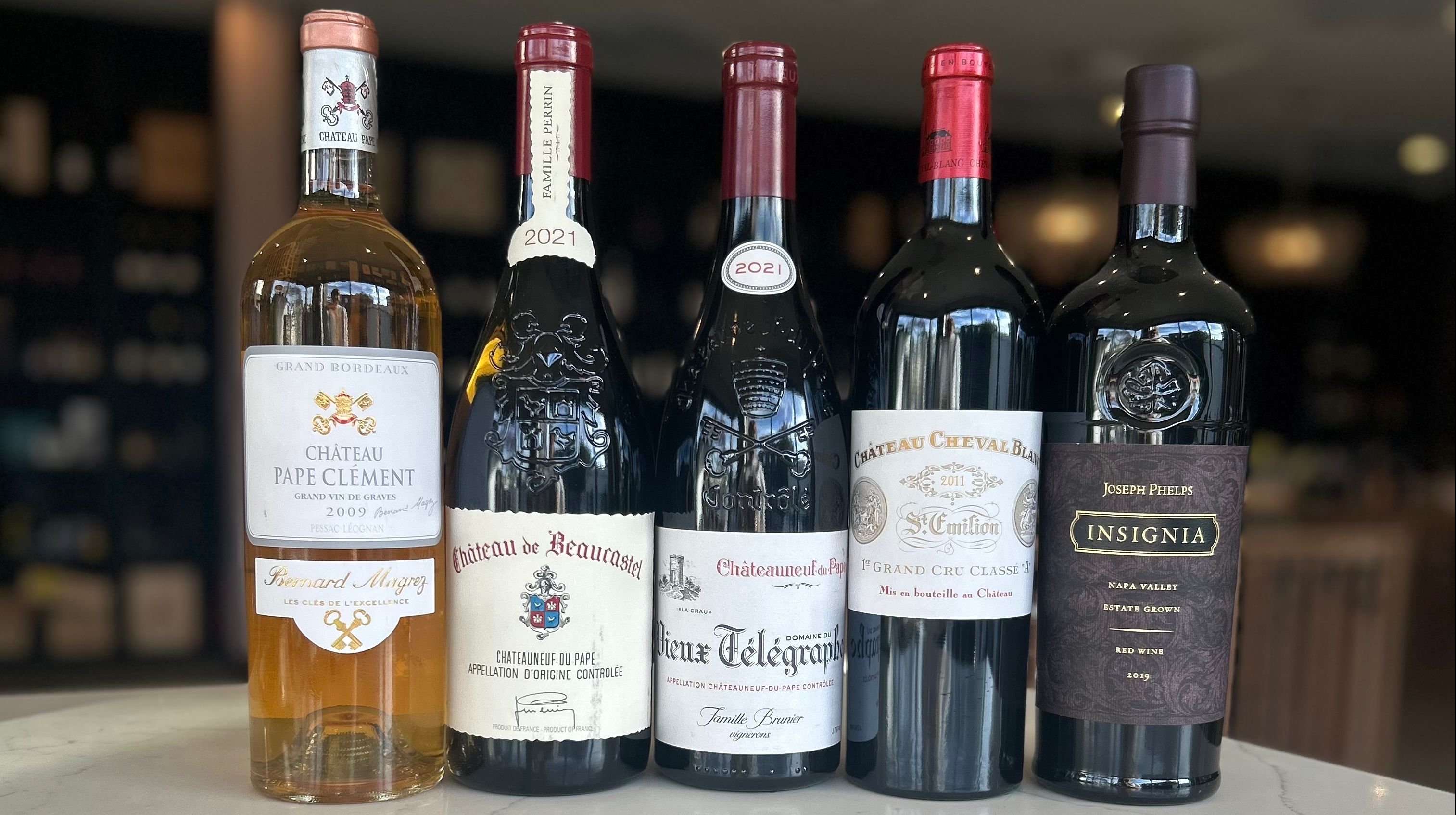
FROM OUR SHELVES: Each of these wines makes the case for the blend in a slightly different way. Different region, different grapes, different philosophy. |
|
2008 Betz Family Bésoleil |
|
Only available by-the-glass at the wine bar!
Intensely aromatic. The wine glass fairly explodes with scents of grape, plum, raspberry and cherry. In the mouth grace notes offer hints of leaf and fresh herb. Plush and irresistible.
|
|
Château Pape Clément Blanc, Pessac-Léognan The blend: 50% Sauvignon Blanc, 40% Sémillon, 10% Sauvignon Gris |
|
A reminder that blending is not only a red wine story. White Bordeaux is one of wine’s genuinely underappreciated categories, and Pape Clément Blanc is one of its finest expressions. Sauvignon Blanc brings citrus, freshness, and aromatic immediacy. Sémillon adds texture, weight, and a waxy lanolin richness that allows the wine to age and develop in ways that pure Sauvignon Blanc can’t. The 10% Sauvignon Gris is the subtlest contribution — a touch of extra spice and body. The result is a white wine that’s interesting right now and will be even more interesting in five years. It’s also priced well below what it would cost if it had a Burgundy appellation on the label. |
|
Château Cheval Blanc, Saint-Émilion Grand Cru The blend: |
|
Cheval Blanc is unusual even by Right Bank standards: most Saint-Émilion estates lean heavily on Merlot, with Cabernet Franc as a supporting player. Cheval Blanc inverts that almost entirely. The result is a wine that smells unlike anything else in the appellation — more floral, more aromatic, more structured, with the graphite and violet lift that Cabernet Franc delivers when it’s the one calling the shots. The 3% Cabernet Sauvignon is essentially symbolic at that level. This is Cabernet Franc’s wine, and it makes a persuasive argument that the grape has been underestimated for most of its history. |
|
2020 The blend: 30% Grenache, 30% Mourvèdre, 15% Syrah, 10% Counoise, 10% other permitted varieties including white grapes |
|
Beaucastel is the most ambitious expression of what Châteauneuf-du-Pape permits. The Mourvèdre content is unusually high for the appellation and Beaucastel also blends in a proportion of white varieties, which gives the wine a richness of texture that’s hard to place on first sip. James Suckling gave it 97 points and called it “very big and elegant” with “incredible mineral freshness.” It’s a wine that rewards patience: open it too young and it’s closed and tannic. Give it time and it becomes something extraordinary. |
|
2021 Vieux Télégraphe The blend: |
|
Vieux Télégraphe is one of the benchmarks of the appellation — the Brunier family has been farming the same plateau of galets roulés northeast of the village since 1898, and the wines taste exactly like that kind of continuity. The 2021 vintage was a cooler, more restrained year than the sun-drenched 2020, which suits Vieux Télégraphe well: the wines show more precision and freshness than is typical, with the Grenache expressing itself in bright red fruit rather than the jammy concentration you get in hotter years. Everything feels a little more lifted and alive. It's a vintage that rewards drinking sooner rather than later, which is not something you can say about Vieux Télégraphe very often. |
|
2019 Joseph Phelps Insignia, Napa Valley The blend: Cabernet Sauvignon-dominant with Merlot, Cabernet Franc, Petit Verdot, and Malbec (varies by vintage) |
|
First produced in 1974, Insignia was one of the first California wines conceived explicitly as a Bordeaux-style blend rather than a varietal bottling. The exact percentages shift with each vintage as the winemaker selects the best lots from across the Phelps estate, which means the wine is always a portrait of the year rather than a fixed formula. The result is unmistakably Californian in its fruit richness and generosity, but with the structure and aging architecture that only a well-constructed blend delivers. It is one of the great American wines, full stop, and it makes the same argument as every bottle in this list: the sum is almost always greater than its parts. |
|
|
|
If this issue sent you down a rabbit hole on any particular bottle or blending tradition, we're always happy to keep the conversation going in store. |